A short take on creativity
Is it up for a change?

We’ve all these moments when we can’t think of something new, cool or breathtaking. We desperately try to come up with an idea, but we’re just stuck.
Nothing going forward, nor backwards.
Fine. Let’s take a step back. Relax and take a look, how we ended up in this situation. We take a deep breath.
First, what’s up with the creativity?
Our ability to come up with new and original ideas. Sometimes this includes making connections between seemingly unconnected things.
Finding uncommon, innovative solutions is another part of this thought process. It’s basically all about our ability to use our brain for helping us to create and discover new things.
This is a true superpower. Not many people realize this. In our daily routines, it’s easy to forget. On some special occasions, it’s more visible. For example, it might a dad who makes his kids laugh by inventing a new simple ball game. A girlfriend who’s genuinely preparing a cozy, romantic date night. Or a mum trying to entertain their kids during a pandemic.

With this superpower in hand, we can improve our day and gift a smile to the people around us. It makes life colorful. Thus, it can be nerve wracking if we seem to have lost this superpower temporarily.
So how do we gain this superpower back?
One problem when we’re stuck is that we’re missing inspiration. We don’t come up with anything. In this case, observing our environment can help.
How did we end up where we’re currently at? Which acts did we take and which were the ones we passed by.
Once we’ve realized how we ended up in our creativity dilemma, we can take specific actions to get out of this tale. We learn from the past and act in the present in order to change our future. This is easier said than done. I know. But once we’re in the process, we’ve basically made it. We keep on improving.
Another problem why we might be stuck can be overthinking. This happens when we still come up with ideas, but we’re full of prejudices.
For example, we notice that it’s a sunny, hot day and people are sweating in a park. A nice cool lemonade would be great. So why not open up a popup lemonade store? Well, it’s old school. It’s not innovative. Who needs lemonade when the supermarket is only a couple of hundred meters away?
By thinking this way, we’re closing down way too many options and possibilities. We’re successfully downgrading our own idea. This is deadly when we’re stuck. Instead of discarding the idea right away, we should address our doubts. Some of them might be relevant, while others aren’t.
If there’s a supermarket in a walkable distance nearby, what could be our unique value proposition? — In this case, we can go all in on convenience. By serving our drinks cold at a reasonable price, we might already gain enough market share. Sometimes it’s way simpler than we think. We just need to break down our idea part by part.
Overthinking and overcomplicating is a common error. But by doing small sized experiments, we can validate our idea. This gives us the necessary confidence to work our way out of our creativity lack.
Back to the main topic. Is creativity up for a change?
So by now we’ve hopefully gotten a common understanding of what creativity is. We know that it is our magic human superpower. With creativity on our side, we can opt in for a better world.
Recently, our superpower got leveraged. AI is here to stay.
You may have heard about large language models. Open AI’s GPT-3 or Google’s PaLM. Although they aren’t perfect, they are sometimes a good form of inspiration. If we’re stuck and need a broad input, those models might help us. They serve inspiration.
Inspiration, really? Yeah, those models have eaten up a large chunk of the internet knowledge. They're like Pac-Man roaming through the World Wide Web craving for knowledge, eating up social media posts, videos, news articles and various other user generated content. The more they eat, or rather process, the better their predictions get.
Regarding the example above. We can ask them to give us a list with 10 ideas how to live healthier. They put out a list, and we can trim it down and adapt it to our individual needs. One might not like fish, so we ask the model to give us an alternative. Seems too good to be true?
But like every technology, they have their cons, right?
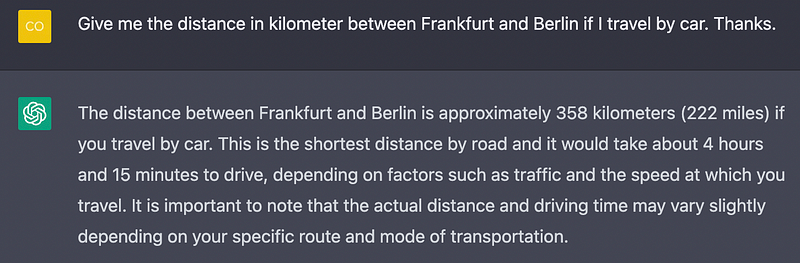
Well, I get it. In some cases, it’s rather stupid. Look at the example below.
A simple question about the distance between two common cities. In this case, the distance between Frankfurt and Berlin. The output of the language model is more of a sophisticated guess rather than explicit knowledge. Even the air distance with 425.04 km (264,11 mi) is larger than the language model predicted.
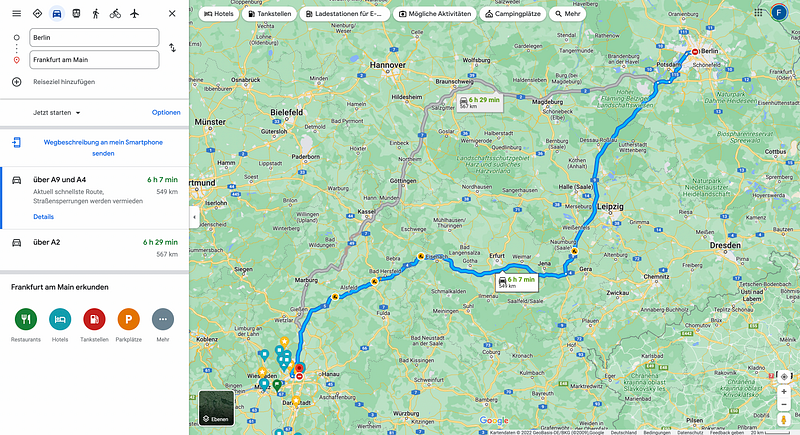
This will get better over time once people hook up the language model to a map service to validate the results. With the newly validated results, the language model can be adapted with a reinforcement learning approach. But currently it’s a huge flaw. The facts a language model spills out need to be validated.
Hm. Okay, so those models can serve inspiration but sometimes fail to provide facts.
What else do they excel at?
In general, those models work exceptionally well when it comes to connect a large range of topics which are well documented. Watch the video below. The workflow of coming up with a custom WordPress plugin is amazing.
The language model accelerates the development time by an order of magnitude. Instead of manually searching through the large mess of documentation, it provides small, easily understandable, custom code examples.
Whether it is a question about some python framework, a frontend JavaScript or some architectural knowledge. The language model got you covered. Sometimes it makes syntax errors or comes up with none existing methods, but overall it gives solid answers. In my opinion, it’s a great start for digging deeper into a new topic and get a grasp of the connections.
A new tool for creative work. A programmable coworker with strengths and weaknesses.
Prompts like the following are great:
Act like a lawyer. Help me write a rent contract for a commercial property.
Outline a first draft.
The language model gives us a structured first draft we can iterate over. With each iteration, we come closer to a favorable result. Sure, it’s not perfect, and we have to validate the model output by hand. But overall, we save quite a bit of time.
Will it replace humans?
tl;dr It’s going to enhance our work. It’s interesting to see that it struggles at rather simple fact questions, but excels at making connections between various topics and putting things into context. Generating, understanding and adapting a text are tasks it is great at.
Does it challenge human creativity?
Definitely. It gives us responses based upon the content we humans created. Thus, the range of possible outputs is enormous. Though sometimes you need to nudge it in a new direction to give original content. Basically, our creativity is still needed. It’s necessary for fine-tuning and validation.
Things previously though impossible are now easily automatable.
With this in mind, it’s going to do more good than bad. In general, it’s still a tool. Yet, it’s a powerful tool. Combined with our superpower creativity in our mind, we’ve yet to experience the largest productivity gain in history.
These models lower the bar for almost every knowledge intensive task. It’s disruptive and will accelerate the pace of civilization moving.
So rather than a competitor for knowledge intensive tasks and huge threat to human creativity, those systems are leveraging our abilities.
You’ve feedback or own thoughts on this topic? Feel free to get in touch with me. We’ve got interesting times ahead. Stay curious.
Additional Resources:
[1] Try out ChatGPT yourself
[2] Build your own AI Application. https://github.com/adrianhajdin/project_openai_codex